Search has always rewarded clarity and credibility. What has changed is the surface where those qualities pay off. Google AI Overviews, ChatGPT, Perplexity, and voice assistants now synthesize answers before a reader reaches the traditional results list, and they draw on the same indexed, crawlable, credible web that organic rankings have always depended on.
This guide consolidates what medspa operators and marketing leads need to know about AI search visibility: what GEO and AEO actually are, what Google officially requires, which editorial practices improve your odds of being cited, and how to measure results honestly. It links to narrower cluster articles for deeper treatment of each topic.
What GEO and AEO Actually Mean
Both terms emerged as practitioners tried to name the editorial adjustments that improve citation rates in generative AI results. Neither is a secret ranking system separate from SEO.
GEO (Generative Engine Optimization) describes the practice of structuring content so that AI systems that generate synthesized answers, Google AI Overviews in particular, can extract, attribute, and cite it accurately. The core practices are: lead with a direct answer, use precise entity language, and ensure your page is indexed and snippet-eligible.
AEO (Answer Engine Optimization) is broader. It encompasses Google's AI features but also extends to ChatGPT's browsing capability, Perplexity's citation model, voice assistants, and any other system that formulates a response rather than returning a list of links. The underlying practices are largely the same; platform differences are mostly a matter of degree.
Both are best understood as editorial and distribution practices layered on top of a sound SEO foundation, not as alternative disciplines that bypass it. A medspa with a technically broken website, thin content, and no off-site credibility will not gain AI citations from answer-first writing alone. Conversely, a clinic that already ranks well in organic search and has strong entity signals is well-positioned to pursue GEO improvements with relatively modest additional effort.
The sequence matters: Fix crawl issues, write genuinely helpful treatment content, and earn credible backlinks before investing heavily in AI-specific optimizations. AI systems surface content that already demonstrates those qualities; they do not rescue content that lacks them.
For a detailed look at ChatGPT and Perplexity specifically, see our supporting article AEO for Medspas: ChatGPT, Perplexity & Voice Search. For a focused look at Google AI Overviews, see How Google AI Overviews Are Changing Medspa Marketing.
What Google Officially Requires for AI-Feature Eligibility
Google Search Central's guidance on AI features is direct: pages become eligible for AI features through the same requirements as standard Search. There is no separate AI crawl, no special opt-in file, and no AI-only markup type. Eligibility depends on:
- Indexability. Google must be able to crawl and index the page. Disallow rules, noindex tags, or login walls block eligibility entirely.
- Snippet eligibility. Pages blocked from snippet display (via
nosnippetormax-snippet:0) cannot be cited in AI summaries, which are themselves a form of snippet. - General technical health. Core Web Vitals, mobile-friendliness, and HTTPS are standard requirements, not AI-specific ones, but failing them reduces overall visibility including in AI features.
Beyond eligibility, Google evaluates content quality through the same helpful-content framework it applies across Search: does this page demonstrate genuine expertise? Does it serve the reader's actual question? Is it trustworthy? These are editorial qualities, not technical checkboxes.
What this means practically: do not let the novelty of GEO language distract you from the fundamentals. A medspa that invests in genuinely helpful treatment content, earns credible mentions across authoritative sources, and keeps its site technically sound is already doing most of what AI-feature eligibility requires.
Answer-First Content Structure
AI synthesis systems extract passages from pages. They favor pages where the relevant answer appears early and clearly, not buried under a history of the clinic, a promotional preamble, or five paragraphs of generic context. This is the single most actionable editorial change most medspa sites can make.
The Answer-First Page Pattern
For every treatment or service page, apply this structure:
- Direct opening answer (first 150 words). State what the treatment is, who it is for, what it costs in your market, and what results are realistic, without hedging until after you have given the reader something substantive.
- Self-contained sections with descriptive headings. Each H2 or H3 section should be understandable in isolation. AI systems frequently extract individual sections rather than entire pages.
- Specific, primary-source facts. Cite the device manufacturer's clinical data, FDA clearance status, or published practitioner guidelines where applicable. Vague claims ("many patients see improvement") are less citable than specific, verifiable ones.
- Explicit FAQ blocks. Structured question-and-answer sections give AI systems pre-packaged passage units aligned to the way patients phrase queries.
- A "Last reviewed" date. Freshness signals matter, especially for treatment content where protocols and pricing change. Date-stamp your content and review it at least quarterly.
What to Avoid
- Opening paragraphs that describe the clinic before the treatment
- Excessive qualifications that bury the core answer
- Duplicate sections lifted from device manufacturer websites verbatim (not original; not authoritative)
- Promotional language in the first paragraph ("We are the #1 provider…")
For a complete framework with worked examples, see our supporting article Answer-First Content for Medspas.
Entity Clarity: Business, Clinicians, Treatments, and Location
AI systems build a model of what your clinic is before deciding whether to cite it. That model is assembled from signals across many sources, not just your website. Ensuring consistency and completeness across all of those signals is what practitioners mean when they talk about "entity clarity."
Business Entity
Your clinic's legal name, address, phone number, and website should be identical across your Google Business Profile, your website's footer and contact page, your schema markup, Yelp, Healthgrades, RealSelf, and any other directory where your clinic is listed. Inconsistency creates ambiguity; AI systems respond to ambiguity by choosing a more clearly defined competitor.
Clinician Entity
Named practitioners with complete bios, credentials, training, specializations, and professional profiles, make a clinic more citable than an anonymous "our team" page. A medical director's NPI number, board certifications, and links to their professional profiles give AI systems verifiable signals about practitioner credibility. This matters especially for procedures where patient safety is a search consideration.
Treatment Language Precision
Use the device or treatment's official name consistently: "Sofwave SYNCHRONOUS ULTRASOUND PARALLEL BEAM PLUS technology" in technical contexts, "Sofwave" in consumer-facing copy. Avoid invented brand names for treatments, and do not use generic descriptors where a specific approved name exists. AI systems trained on clinical and medical literature recognize precise terminology and weigh it accordingly.
Location Signals
Geographic context should appear naturally throughout treatment pages, not stuffed at the end of a title tag. Reference the service city in the opening paragraph, in FAQ answers ("Sofwave in Pasadena typically ranges from…"), and in any before-and-after descriptions. This helps AI systems associate your clinic with specific local queries.
Schema Markup: Its Real Role and Its Limits
Schema markup is machine-readable clarification. It tells search systems what type of content a page contains, that a block of text is a price range for a specific service, that a question-and-answer block is an FAQ, that your business is a medical spa located at a specific address. It does not add authority that the underlying content does not already have, and it does not guarantee any specific ranking position, rich-result appearance, or AI citation.
Schema Types Worth Implementing
| Schema Type | Where to Apply | What It Clarifies |
|---|---|---|
LocalBusiness / MedicalBusiness |
Homepage, contact page | Name, address, phone, hours, geo-coordinates, business type |
Service / MedicalProcedure |
Treatment pages | Treatment name, description, price range, provider |
FAQPage |
Pages with Q&A sections | Question text and answer text as machine-readable pairs |
BreadcrumbList |
All interior pages | Page hierarchy and navigation path |
Article / BlogPosting |
Blog and editorial pages | Author, date published, date modified, headline |
What Schema Cannot Do
- Override thin or unhelpful content. Schema on a low-quality page adds metadata to a low-quality page.
- Force a rich result or AI citation. Google decides whether to display rich results and AI features based on quality signals well beyond markup.
- Substitute for consistent NAP data in actual text. Both the visible text and the schema should match your Google Business Profile exactly.
- Compensate for indexing problems. If the page cannot be crawled, schema on it is irrelevant.
For a detailed guide to medspa schema implementation and the most common mistakes, see Medspa Schema Markup: What It Does, and What It Doesn't.
Third-Party Corroboration and Off-Site Signals
AI systems do not rely solely on your website. They cross-reference what your site claims against what other credible sources say about your clinic. This corroboration step is why off-site signals remain foundational, not just for traditional SEO but for AI-feature eligibility.
The Signals That Matter
Reviews. Google Business Profile reviews signal that real patients have visited your clinic and found it credible. Volume, recency, and rating all appear to influence AI citations for local queries. An active review generation practice, asking every patient, responding to every review, is one of the highest-leverage activities a medspa can maintain. Review solicitation must comply with Google's policies and FTC endorsement guidance: no incentivized reviews, no filtering by sentiment.
Directory and citation consistency. Accurate, consistent listings on Healthgrades, RealSelf, Yelp, the American Med Spa Association directory, and state medical-board licensee lookup pages give AI systems redundant confirmation of your business's identity and location.
Editorial backlinks and mentions. Coverage in local news, health and beauty publications, and industry media provides the kind of third-party corroboration that AI systems weight most heavily. A single well-placed article in a regional lifestyle magazine that names your clinic as an expert source is more valuable than dozens of low-authority directory entries.
Original media. Video content, particularly procedure walkthroughs, practitioner interviews, and patient journey videos published on YouTube, appears in AI results and creates additional indexed entity associations. Original photography with descriptive alt text and geolocation metadata adds to the same effect.
Crawl and Index Fundamentals
No amount of editorial optimization helps a page that Google cannot find or read. Before investing in GEO improvements, verify that your treatment pages are actually indexed.
Quick Diagnostic Checklist
- Check indexing: Run
site:yourdomain.com [treatment name]in Google Search. If the treatment page does not appear, investigate why. - Google Search Console Coverage report: Review the Indexing report for "Not indexed" reasons, Crawled but not indexed, Discovered but not currently indexed, and Excluded by noindex tag each require a different fix.
- Robots.txt: Confirm that treatment pages, blog posts, and any pages you want cited are not blocked.
- Canonical tags: Ensure self-referencing canonicals are correct and that paginated or filtered versions of treatment listings do not canonicalize away from the primary URL.
- Internal links: Every treatment page should be reachable from at least one crawlable internal link, ideally from the navigation and from relevant blog content.
- XML sitemap: Include all canonical treatment and service URLs; submit to Search Console.
If a page is indexed but not appearing in AI Overviews for relevant queries, the issue is almost always content quality or off-site authority, not a technical barrier that schema will solve.
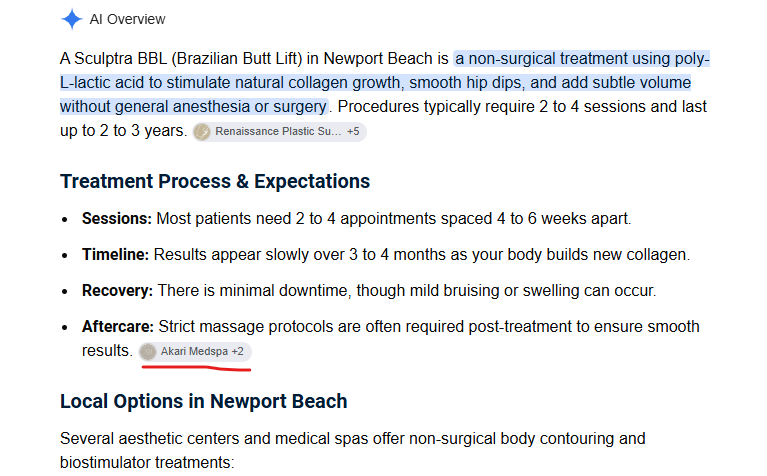
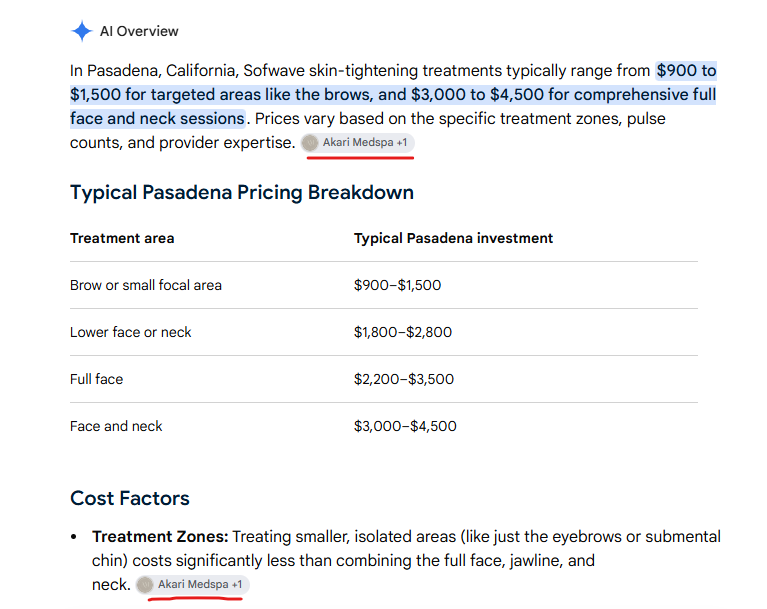
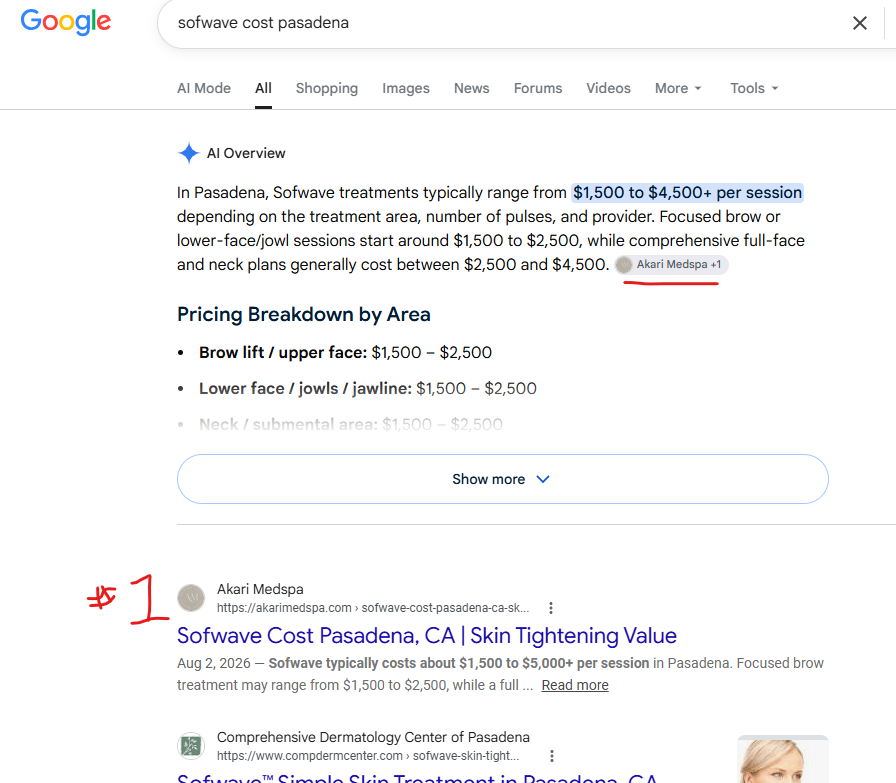
First-Party Evidence: Akari Medspa in Pasadena
The evidence gallery following this guide contains supplied Google Search screenshots captured in August 2026. They show Akari Medspa, the clinic Prova Haus operates directly, appearing in specific AI Overview and organic-result snapshots. They are examples from a particular moment, not proof that a single tactic caused the placements or a guarantee that the same citations will persist.
Important context: AI Overviews are dynamic, the same query can produce different cited sources on different days or in different locations. SEO fundamentals make inclusion possible; they do not make any citation certain.
Visit our Results page for captured Google and AI-search appearances. Our SEO management supports clear, useful content for search and AI understanding; these examples do not guarantee citations, rankings, or bookings.
Measuring AI Search Visibility
Measurement is the area where AI search is most genuinely immature. No single tool provides complete, reliable AI citation data. Use a combination of signals and treat the picture as directional.
The Most Reliable Proxy: Google Search Console
Search Console does not explicitly separate AI Overview clicks from traditional organic clicks, but it remains your most trustworthy source of overall search performance. Monitor impressions and clicks for your target treatment queries; if you are being cited in AI Overviews for a query, you will typically see branded click-through rates rise even if impressions for that query stay flat.
GA4 Referral Traffic
AI platforms that browse the web show up in GA4 as referral traffic. Filter for sources like chatgpt.com, perplexity.ai, and bing.com (which powers Copilot). Volume is typically small, but growth trends are meaningful.
Manual Spot-Checks
Search for your five or ten most important treatment and pricing queries in an incognito window from your local market. Note whether an AI Overview appears, whether your clinic is cited, and who else is cited. This is slow but currently the most reliable method for understanding your AI visibility status. Run it monthly and log the results.
Third-Party Monitoring Tools
Several platforms, including Semrush AI Toolkit, Authorityweb, and BrightEdge, offer AI Overview tracking features as of mid-2026. Coverage and accuracy vary; use them as a complement to manual checks, not a replacement.
For a full measurement protocol, including how to set up a GA4 AI referral segment and a manual audit template, see How to Track Your Medspa's Visibility in AI Search.
Quarterly AI-Search Audit Checklist
AI search moves faster than traditional SEO. Platform behaviors, Google's AI Overview patterns, and citation norms change. A quarterly review, not a one-time setup, keeps your strategy current.
Every Quarter: Core Review
- ☐ Run manual spot-checks for top 10 treatment + pricing queries; log results and changes from last quarter
- ☐ Review Google Search Console for impression and click trends on AI-relevant queries
- ☐ Check GA4 for AI platform referral traffic; compare to prior period
- ☐ Confirm all primary treatment pages are indexed (Search Console Coverage report)
- ☐ Update "Last reviewed" dates on any treatment pages that have not been touched in 90 days
- ☐ Verify Google Business Profile information: hours, services, photos, recent posts
- ☐ Check review volume and recency on Google; respond to any unresponded reviews
Every Quarter: Content & Schema
- ☐ Validate schema with Google's Rich Results Test for the three most important treatment pages
- ☐ Confirm FAQPage schema matches the visible FAQ text exactly
- ☐ Review pricing information on treatment pages for accuracy; update if fees have changed
- ☐ Identify one page per quarter to restructure with a stronger answer-first opening
Every Quarter: Off-Site Signals
- ☐ Check NAP consistency across Google Business Profile, Yelp, Healthgrades, and RealSelf
- ☐ Note any new editorial mentions or backlinks earned this period
- ☐ Review practitioner bios for completeness and link to professional profiles
- ☐ Identify one editorial backlink or media opportunity to pursue next quarter
We connect this technical framework with AI visibility services for medspas, using accessible pages and verified practice information rather than a citation promise.