
AI search measurement is the most uncertain part of any AI visibility strategy, and the gap between what practitioners claim to track and what they can actually track reliably is significant. This article gives you an honest picture of what is measurable, what is directional, and what to do with the information you collect.
It supports the AI Search Visibility for Medspas pillar guide, which covers the full strategic context. This article focuses exclusively on measurement.
Why AI Search Measurement Is Genuinely Hard
Traditional SEO measurement is imperfect but tractable: Google Search Console provides impression and click data by query, Google Analytics tracks organic sessions, and rank-tracking tools show position changes over time. The picture is incomplete, "not provided" keyword data, sampling in analytics, and rank personalization are long-standing limitations, but the core data loop is reliable.
AI search adds meaningful complexity:
- No dedicated AI Overview segment in Search Console. Clicks from AI Overview citations are included in the organic performance report but are not separated from traditional organic clicks. Google has not announced a timeline for adding this distinction.
- AI responses are dynamic and personalized. The same query can produce different AI Overviews for different users, locations, and even the same user on different days. A snapshot of your AI visibility at one moment does not describe what most users see.
- Referral traffic from AI assistants is small but growing. ChatGPT, Perplexity, and similar platforms do send referral traffic, but it is typically a small fraction of overall organic traffic for local medspa queries, making trend analysis more reliable than absolute volume comparison.
- Third-party tracking tools are still maturing. Several platforms now offer AI Overview monitoring, but methodologies differ, local market coverage is uneven, and the tools update their approaches as Google's AI features change.
None of these limitations mean measurement is pointless. They mean you should triangulate across multiple signal types rather than relying on a single number.
Signal Type 1: Google Search Console (Most Reliable)
Google Search Console remains the most trustworthy data source for overall search performance, including the effect of AI Overview presence on your visibility.
What to Monitor
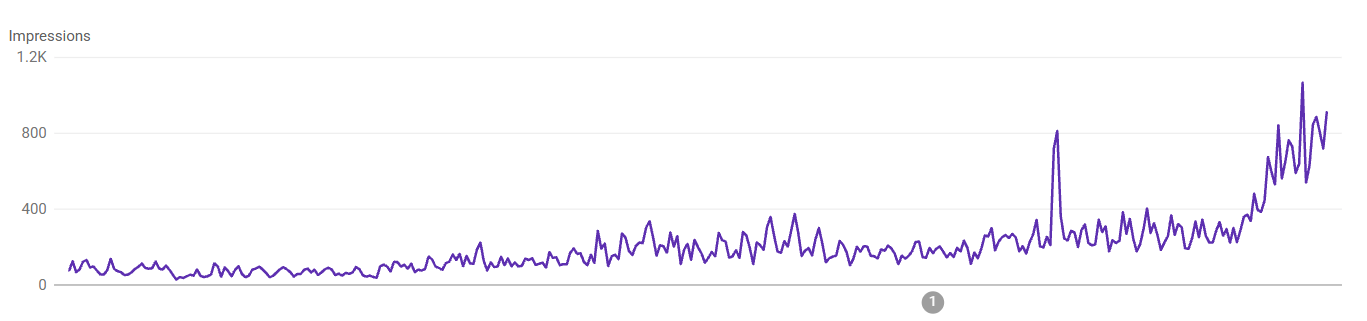
Query-level impressions and clicks for treatment terms. Filter the Performance report by your top treatment queries (e.g., "Sofwave Pasadena," "Botox near me [city]," "Morpheus8 cost [city]"). Track 90-day trends. An AI Overview presence for a query often coincides with a click-through rate change, because the AI summary captures some clicks that would have gone to position #1, reducing CTR for that rank position while raising overall visibility value for cited sources.
Branded query growth. An increase in searches for your clinic's name, especially from users who found your clinic in an AI Overview first, shows up as branded impressions growth. This is an imperfect but practical proxy for AI awareness.
Position 1 CTR changes. If you are ranking position 1 for a query that now has an AI Overview, you may see your CTR for that position decrease even if your ranking is unchanged. This is not necessarily a sign of deteriorating performance, it may reflect AI Overview presence capturing some intent. Impressions remaining stable while CTR falls slightly is a known pattern for AI Overview queries.
How to Set Up Your Query Monitoring
- In Search Console, go to Performance > Search Results.
- Select the last 90 days and compare to the prior 90-day period.
- Filter by Query and add your top 10–15 treatment and pricing terms.
- Export to a spreadsheet and log the results monthly. The trend over six months is more meaningful than any single snapshot.
Signal Type 2: GA4 AI Referral Traffic
When users follow a link from an AI assistant's response to your site, GA4 records that session with the referring domain. For a local medspa, this traffic is usually small, but it is real and growing.
Setting Up an AI Referral Segment
- In GA4, go to Explore and create a new Free Form exploration.
- Add a Segment with the condition: Session Source contains
chatgpt.comORperplexity.aiORbing.com(for Copilot) ORclaude.ai. - Track this segment monthly alongside your standard organic traffic. Note the landing pages, they tell you which content is earning AI assistant citations.
Also monitor the standard Traffic Acquisition report (Acquisition > Traffic Acquisition) and sort by Session Medium. Referral traffic from AI sources will appear there without requiring a custom segment.
Signal Type 3: Manual Spot-Checks (Most Accurate for Local)
For local medspa queries, manual checking is currently the most reliable way to understand your AI Overview status. Automated tools cannot fully account for geographic personalization or the dynamic nature of AI Overview appearance.
Manual Audit Protocol
- Open an incognito or private browsing window.
- Search for each of your top 10 treatment and pricing queries from your clinic's city (use a VPN set to your local area if you are checking from a different location).
- Note: (a) whether an AI Overview appears, (b) whether your clinic is cited, (c) which other clinics are cited, (d) what content is visible in the citation.
- Log the results in a simple spreadsheet with the date. Screenshot any citations for your records.
- Repeat monthly. Review quarterly for trend patterns.
Monthly AI Visibility Log Template
| Query | AI Overview? | Your clinic cited? | Competitors cited | Notes |
|---|---|---|---|---|
| [treatment] [city] | Yes / No | Yes / No | [names] | [what section] |
Signal Type 4: Third-Party Monitoring Tools
As of August 2026, several platforms offer AI Overview tracking functionality worth knowing about:
- Semrush AI Overview Tracker: Tracks AI Overview presence for tracked keywords and shows which sources are being cited. Most useful for monitoring competitive queries at scale.
- BrightEdge Generative Parser: Enterprise-level tool with AI Overview tracking integrated into its broader rank and visibility suite.
- Authoritas AI Visibility: Tracks AI Overview appearances and source citations with market-level reporting.
- Otterly.ai: Focused specifically on AI answer monitoring across multiple platforms including ChatGPT and Perplexity.
Use any of these as a supplement to, not a replacement for, manual checks and Search Console analysis. Their local market coverage varies, and their methodologies change as Google's AI features evolve.
What to Do with the Data
Measurement without action is documentation. When you find that a query consistently shows an AI Overview where you are not cited, work backwards through the likely causes:
- Is the relevant page indexed? Check Search Console's Index Coverage report. If it is not indexed, schema and content improvements are irrelevant until crawl and index issues are resolved.
- Does the page lead with a direct answer? Open the page and read the first 150 words. If the answer is buried, restructure it. See Answer-First Content for Medspas.
- Are reviews recent and sufficient? A thin review profile is one of the most common barriers to local AI citation. If competitors being cited have substantially more recent reviews, that gap is worth addressing before making content changes.
- Is your entity consistent off-site? Check NAP consistency on Google Business Profile, Yelp, Healthgrades, and RealSelf. Inconsistency creates entity ambiguity that reduces AI citation confidence.
We use the observations to prioritize AI visibility improvements for medspas, keeping citations, referrals, and confirmed consultations separate.